

Thumbs Up - Thumbs Down - New Ideas - Recognition
Quick signals plus brainstorming and explicit appreciation.
Thumbs up
What should we celebrate or reinforce?
Thumbs down
What frustrated people—keep discussion blameless.
New ideas
Proposals or experiments worth considering.
Recognition
Shout-outs for help, mentorship, or going above and beyond.
This board is for demo purposes only. Your responses are not saved. Close or refresh the page to clear all cards. Do not add any sensitive information.
What is Thumbs Up - Thumbs Down - New Ideas - Recognition?
Thumbs Up - Thumbs Down - New Ideas - Recognition is a four-column retrospective format that combines rapid feedback with creative brainstorming and explicit peer appreciation. The format emerged from agile coaching practices that observed a critical gap in most retrospective formats: the absence of direct interpersonal recognition. While formats like Mad Sad Glad address emotions and Start-Stop-Continue addresses processes, this format uniquely carves out dedicated space for celebrating individuals.
The four columns serve distinct purposes. "Thumbs Up" captures quick positive signals—things that worked well and felt right. "Thumbs Down" collects quick negative signals—things that frustrated or disappointed. "New Ideas" opens a creative brainstorming space for innovations, experiments, or approaches the team has not tried. "Recognition" creates an explicit channel for peer-to-peer appreciation—shout-outs, gratitude, and acknowledgment of exceptional contributions.
The inclusion of both New Ideas and Recognition makes this format particularly well-suited for teams that want to balance continuous improvement with team cohesion. Many retrospective formats are excellent at finding problems but poor at fostering creativity and connection. This format addresses both needs in a single session, making it efficient for teams that cannot afford separate improvement and team-building meetings.
When to use Thumbs Up - Thumbs Down - New Ideas - Recognition
This format is ideal for teams that need a morale boost or that are in a creative phase where new ideas are welcome. Use it after a sprint where the team delivered well but feels disconnected, or when innovation has stagnated and the team needs encouragement to think differently. It is also excellent for teams that work hard but rarely acknowledge each other contribution—the Recognition column fills a fundamental human need that task-focused formats overlook.
The format works well for teams of four to twelve people and fits into a 45 to 60 minute session. It is particularly effective for remote teams where casual recognition that would happen naturally in an office—a quick "great job on that fix"—is lost. The dedicated Recognition column ensures these moments are not skipped.
Use this format every four to six sprints as a complement to your regular retro format, or more frequently if your team culture is recognition-poor. Avoid it when the team has serious systemic issues to resolve—the breadth of four columns may spread discussion too thin when focus on one or two critical problems is needed.
How to facilitate Thumbs Up - Thumbs Down - New Ideas - Recognition
Set up the four columns with clear labels and brief descriptions. Give the team six to eight minutes for silent writing across all columns. Encourage at least one card in Recognition—making recognition mandatory (even if optional to share aloud) ensures it happens rather than being an afterthought.
Process in this order: Recognition first to set a warm, appreciative tone. Read each recognition card aloud and give the recipient a moment to respond. Then move to Thumbs Up for a quick celebration of wins. Next, Thumbs Down for a focused discussion on frustrations—group related items and dot-vote for the top two to address. Finally, New Ideas to end on a forward-looking, creative note.
For the New Ideas column, change the facilitation style from analytical to generative. Instead of evaluating each idea ("would this work?"), collect them all and then have the team vote on which idea to try as an experiment. Treat New Ideas as a brainstorm—no judgment during generation, evaluation afterward. Close the session by converting the top Thumbs Down issue into an action item and selecting one New Idea to experiment with. Read back the Recognition cards once more as a closing ritual.
Tips for getting the most out of Thumbs Up - Thumbs Down - New Ideas - Recognition
The Recognition column has an outsized impact on team health when done well. Coach participants to be specific: "Thanks to Jamie for staying late to fix the production issue" is good, but "Thanks to Jamie for noticing the database timeout before it affected customers, and for documenting the fix so the on-call team knows how to handle it next time" is transformative. Specific recognition reinforces the exact behaviors you want to see repeated.
Do not let Thumbs Down dominate the session. With four columns competing for time, allocate roughly 20 percent to Recognition, 15 percent to Thumbs Up, 35 percent to Thumbs Down, and 30 percent to New Ideas. If Thumbs Down consistently overflows, it may indicate the team needs a dedicated problem-solving session separate from this broader format.
The New Ideas column often produces the highest-value outcomes of the entire retro. Teams that feel safe to brainstorm freely generate innovations that structured improvement formats miss. Protect this creative space from premature judgment. An idea that sounds impractical at first—"What if we had no meetings on Wednesdays?"—might lead to a genuinely valuable experiment.
Variations and adaptations
For remote teams, the Recognition column benefits from a visual element. Consider having team members submit a short GIF or emoji alongside their recognition to add personality and warmth. Some remote teams create a dedicated Recognition Slack channel where retro recognition cards are posted after the session, extending the positive impact beyond the meeting itself.
For async retros, open the Recognition and New Ideas columns first—these are the columns that benefit most from thoughtful, asynchronous contribution. Give the team 48 hours to add recognition and ideas, then open Thumbs Up and Thumbs Down 24 hours before the synchronous session. The live meeting focuses on discussing Thumbs Down items and selecting New Ideas to try, with Recognition cards read aloud at the start as an energizing ritual.
A popular variation replaces Thumbs Down with "Puzzles"—things the team does not understand or finds confusing. This reframing shifts the energy from complaints to curiosity and works well for teams that tend toward negativity. Another adaptation adds a "Spotlight" element where one team member each retro gets a dedicated three-minute recognition segment, ensuring that over time everyone receives meaningful, public appreciation. This rotation prevents recognition from always flowing to the most visible contributors.

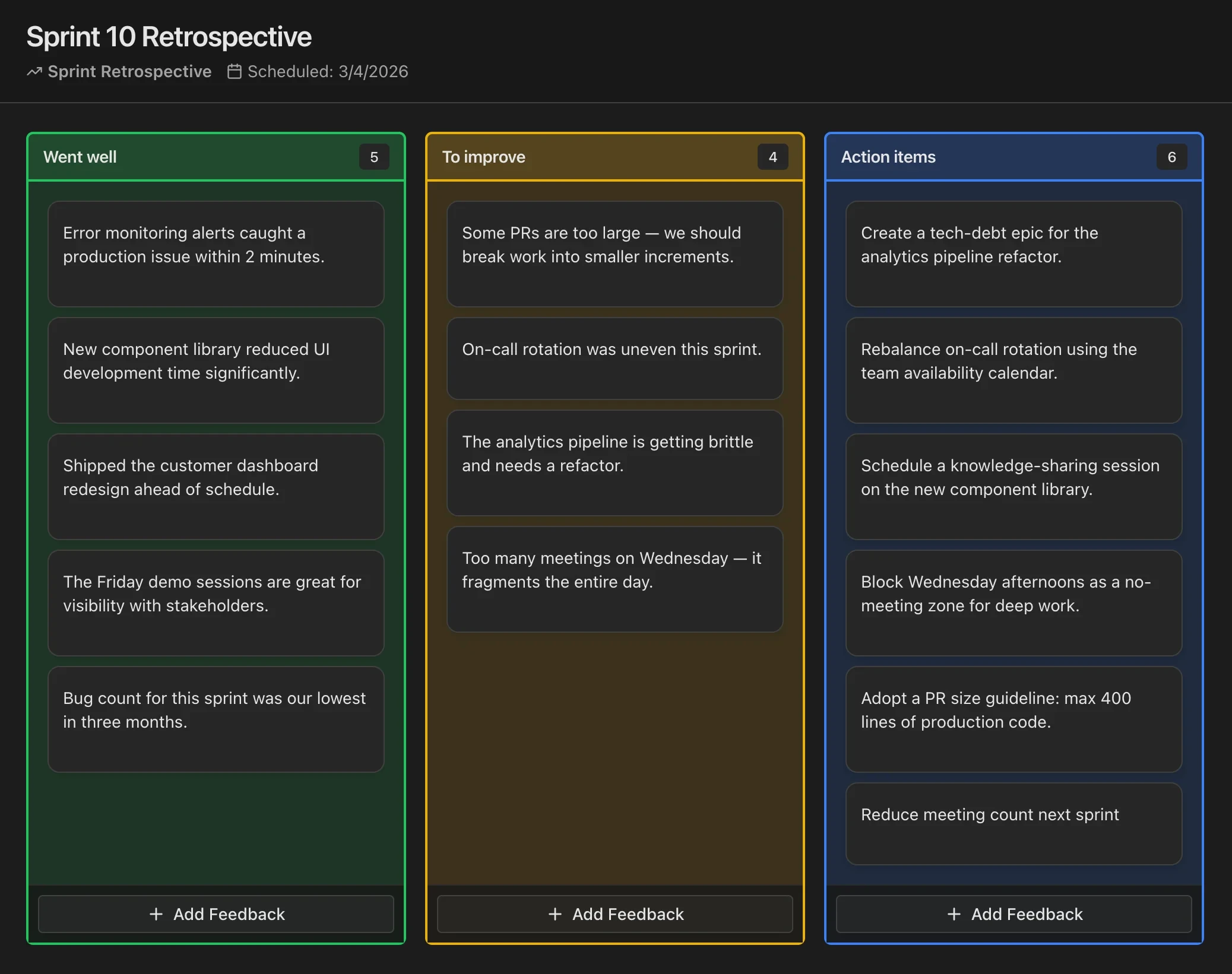
Run Retrospectives in CodeKudu
CodeKudu includes dozens of retrospective board templates, anonymous feedback, AI summaries, and action items that sync to GitHub Issues, Jira, and Linear.