

Starfish Retrospective
Five lenses on current practice: keep, more, less, stop, and start—great for tuning ways of working.
Keep doing
Behaviors and practices that are working—protect them.
More of
What deserves greater emphasis or investment?
Less of
What should be reduced without removing entirely?
Stop doing
What should end because it does not pay off?
Start doing
New experiments or commitments to try next.
This board is for demo purposes only. Your responses are not saved. Close or refresh the page to clear all cards. Do not add any sensitive information.
What is the Starfish Retrospective?
The Starfish Retrospective was created by Patrick Kua, an experienced agile coach and technologist, as an evolution of the simpler Start-Stop-Continue format. By adding "More Of" and "Less Of" to the mix, Kua created a five-point model that captures nuance that binary start/stop categories miss. The name comes from the visual layout: five arms radiating from a center point, each representing a different type of change.
The five categories span a full spectrum of change intensity. "Keep Doing" preserves current strengths. "More Of" amplifies practices that work but are underinvested. "Less Of" dials down activities that are overdone. "Stop Doing" eliminates waste entirely. "Start Doing" introduces new experiments. This gradient gives teams a richer vocabulary for calibrating their ways of working.
The Starfish is particularly powerful because it acknowledges that most process improvements are not binary. Saying "stop doing code reviews" is extreme, but "do less synchronous code review and more async review" captures the nuance the team actually needs. This graduated approach to change reduces resistance because people are more willing to adjust intensity than to completely abandon a practice.
When to use the Starfish Retrospective
The Starfish is ideal when your team has a mature set of practices that need fine-tuning rather than wholesale replacement. It works best mid-project when the team has established routines but senses they are not optimally calibrated. Use it quarterly or every six to eight sprints as a comprehensive ways-of-working review, complementing simpler formats used for regular sprint retros.
Teams of five to ten people benefit most from the five-column structure. Smaller teams may find the distinction between "More" and "Start" or "Less" and "Stop" artificial. Larger groups should use breakout sessions. The format requires a 60 to 75 minute time slot because five columns need more processing time than three.
This format is especially valuable when your team has recently adopted several new practices and needs to evaluate which ones to double down on, which to scale back, and which to abandon. It is also excellent after a team health survey reveals mixed signals—the five categories help decompose vague sentiment into specific, actionable feedback.
How to facilitate the Starfish Retrospective
Draw a five-pointed star on the board and label each arm. Explain each category with a concrete example from the team context—this calibration step is important because the difference between "Less" and "Stop" or "More" and "Start" can be confusing without examples. Give the team eight to ten minutes for silent writing, encouraging at least one card per arm.
Process the arms in this order: Keep, More, Less, Stop, Start. Starting with Keep establishes what is working. Moving to More reinforces positivity by discussing amplification of good things. Less and Stop address reduction and elimination. Ending with Start creates forward momentum. For each arm, cluster similar items and facilitate brief discussion on the top-voted themes.
The key facilitation challenge is helping people place items in the right category. If someone puts "code reviews" in both "More" and "Less," explore what specifically about code reviews needs adjustment—perhaps more async reviews and fewer blocking synchronous reviews. This decomposition is where the real insight lives. Close by selecting one commitment from each of the five categories to create a balanced improvement portfolio.
Tips for getting the most out of the Starfish Retrospective
The biggest trap is treating all five arms equally in terms of time investment. In practice, "Keep Doing" rarely needs extended discussion—a quick acknowledgment is usually sufficient. Spend the most time on "More Of" and "Less Of" because these are the nuanced categories where the richest insights emerge. A good time split is 10 percent on Keep, 25 percent each on More and Less, 20 percent on Stop, and 20 percent on Start.
Avoid letting "Less Of" become a passive-aggressive version of "Stop." If someone writes "less micromanagement" in the Less column, they probably mean "stop micromanagement." Help them distinguish genuine gradation from softened complaints. The Less column should contain items where some amount of the practice is genuinely valuable but the current dosage is too high.
Make action items specific about the degree of change. "Do more pair programming" is vague. "Schedule two pair programming sessions per sprint instead of zero, rotating partners each time" is actionable and measurable. The Starfish format rewards specificity because the whole point is calibration rather than binary change.
Variations and adaptations
For remote teams, use a digital whiteboard template with five clearly labeled zones. Anonymous card submission works well here because the five categories can reveal uncomfortable truths—especially "Stop Doing" items that may feel personal. Consider using emoji reactions on cards during async review so the team can signal agreement before the synchronous session.
For asynchronous distributed teams, run the starfish as a week-long exercise. Post one category per day from Monday to Friday, asking people to contribute and react throughout the day. Friday becomes a synchronous synthesis session. This drip approach prevents cognitive overload and gives people time to reflect on each dimension separately.
A common variation reorganizes the arms into a circular dial from "Stop" to "Less" to "Keep" to "More" to "Start," creating a visual spectrum from removal to addition. This layout makes the gradient nature of the format more intuitive. Another adaptation for technical teams adds a sixth arm: "Measure"—things the team suspects need change but lacks data to decide the direction. This surfaces the need for metrics and monitoring as a first step before committing to More or Less.

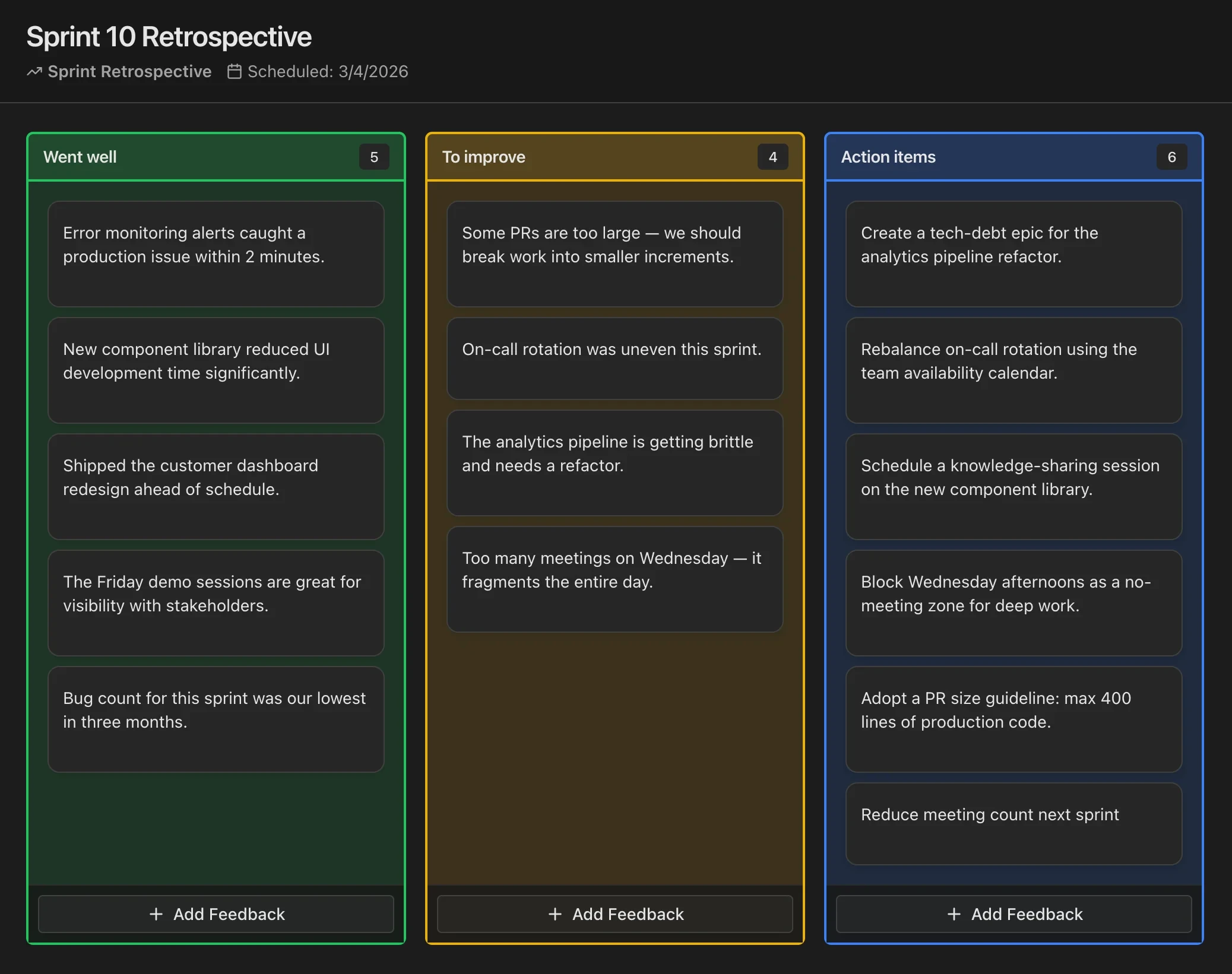
Run Retrospectives in CodeKudu
CodeKudu includes dozens of retrospective board templates, anonymous feedback, AI summaries, and action items that sync to GitHub Issues, Jira, and Linear.