

Plus Delta
Simple plus and delta columns keep feedback constructive and easy to scan.
Plus
What worked well and should continue or spread?
Delta
What should change? Frame as opportunities, not attacks.
This board is for demo purposes only. Your responses are not saved. Close or refresh the page to clear all cards. Do not add any sensitive information.
What is Plus Delta?
Plus Delta is one of the most streamlined retrospective formats available, using only two columns to capture team feedback. The format has its roots in educational assessment and military after-action reviews, where instructors and commanders would separate observations into "what went well" (plus) and "what should change" (delta). The Greek letter delta (Δ) symbolizes change in mathematics and science, and its use here is deliberate—the column is about change, not criticism.
The format was adopted by agile teams who wanted a retrospective structure that was faster and more constructive than traditional plus/minus formats. The critical design choice of using "delta" instead of "minus" or "negative" fundamentally shifts the conversation from blame to opportunity. When you ask "what should change?" instead of "what went wrong?", you invite solution-oriented thinking from the start.
Plus Delta is the Swiss Army knife of retrospectives. It works for sprint retros, project post-mortems, meeting evaluations, workshop debriefs, and even personal reflection. Its simplicity makes it universally accessible—no metaphor to explain, no complex categorization to learn. Two columns, two questions, and a path forward.
When to use Plus Delta
Plus Delta is the ideal default format for teams that are new to retrospectives or for contexts where time is extremely limited. A productive Plus Delta session can run in as little as 15 to 20 minutes, making it practical for teams that struggle to carve out time for longer retros. It is also excellent for non-engineering contexts—use it after client meetings, workshops, presentations, or any collaborative event.
The format scales well across team sizes. For pairs or trios, it works as a quick verbal exchange. For teams of ten to fifteen, it remains manageable because two columns are fast to process even with many cards. It suits any sprint phase and any project maturity level. Use it when simplicity matters more than depth.
Avoid Plus Delta when the team has complex, systemic issues that need decomposition into multiple categories. If you find that your delta column consistently generates items that range from minor tweaks to fundamental process changes, a more granular format like the Starfish or DAKI would serve you better. Also consider alternatives when the team needs emotional processing—Plus Delta is analytical by nature and may not create space for feelings.
How to facilitate Plus Delta
The beauty of facilitating Plus Delta is its minimal setup. Draw a vertical line on the board, label the left side "Plus" (or "+") and the right side "Delta" (or "Δ"). Give the team three to five minutes of silent writing time—shorter than most formats because there are only two categories to think about.
Process the Plus column first and quickly. Have each person briefly explain their cards, group duplicates, and move on. Spend no more than a third of your total time on plusses. Then move to the Delta column, which is where the real facilitation work happens. For each delta, ask: "What specifically should change, and what would that look like?" Push for specificity—"better communication" becomes "a five-minute async update in Slack after every stakeholder meeting."
After processing all deltas, dot-vote on the top two or three. For each selected delta, spend two to three minutes converting it into a concrete action: who will do what by when? Close the retro by reading back the commitments. The entire session should take 20 to 30 minutes for a team of five to seven people.
Tips for getting the most out of Plus Delta
The biggest risk with Plus Delta is that its simplicity encourages shallow feedback. "Communication" in the delta column tells you nothing. Coach your team to be specific: "The handoff between design and engineering this sprint had no documented acceptance criteria, which caused two rounds of rework." Specificity transforms vague concerns into actionable improvements.
Another common issue is delta fatigue—teams that run Plus Delta every sprint may find the delta column becomes repetitive because the same systemic issues reappear. If you see the same deltas three sprints in a row, it signals either that action items are not being followed through or that the issue requires escalation beyond the team. Use this pattern as a diagnostic signal rather than ignoring it.
Do not undervalue the Plus column. Research on team performance consistently shows that teams that regularly acknowledge what is working outperform teams that focus exclusively on problems. The Plus column builds collective efficacy—the team belief that "we can do this." Make celebrating wins a genuine practice, not a perfunctory warm-up before getting to the "real" discussion.
Variations and adaptations
For remote teams, Plus Delta is one of the easiest formats to run asynchronously. Share a two-column board, give the team a few hours to add cards, and then hold a 15-minute synchronous session focused on voting and action planning. The low overhead makes it practical even for distributed teams with minimal overlap in working hours.
For meeting evaluations, run a rapid Plus Delta at the end of any team meeting that lasted more than 30 minutes. Give people 60 seconds to silently add one plus and one delta, then spend two minutes reviewing. This micro-retro habit builds continuous improvement into everyday team interactions and normalizes feedback as a routine rather than a special event.
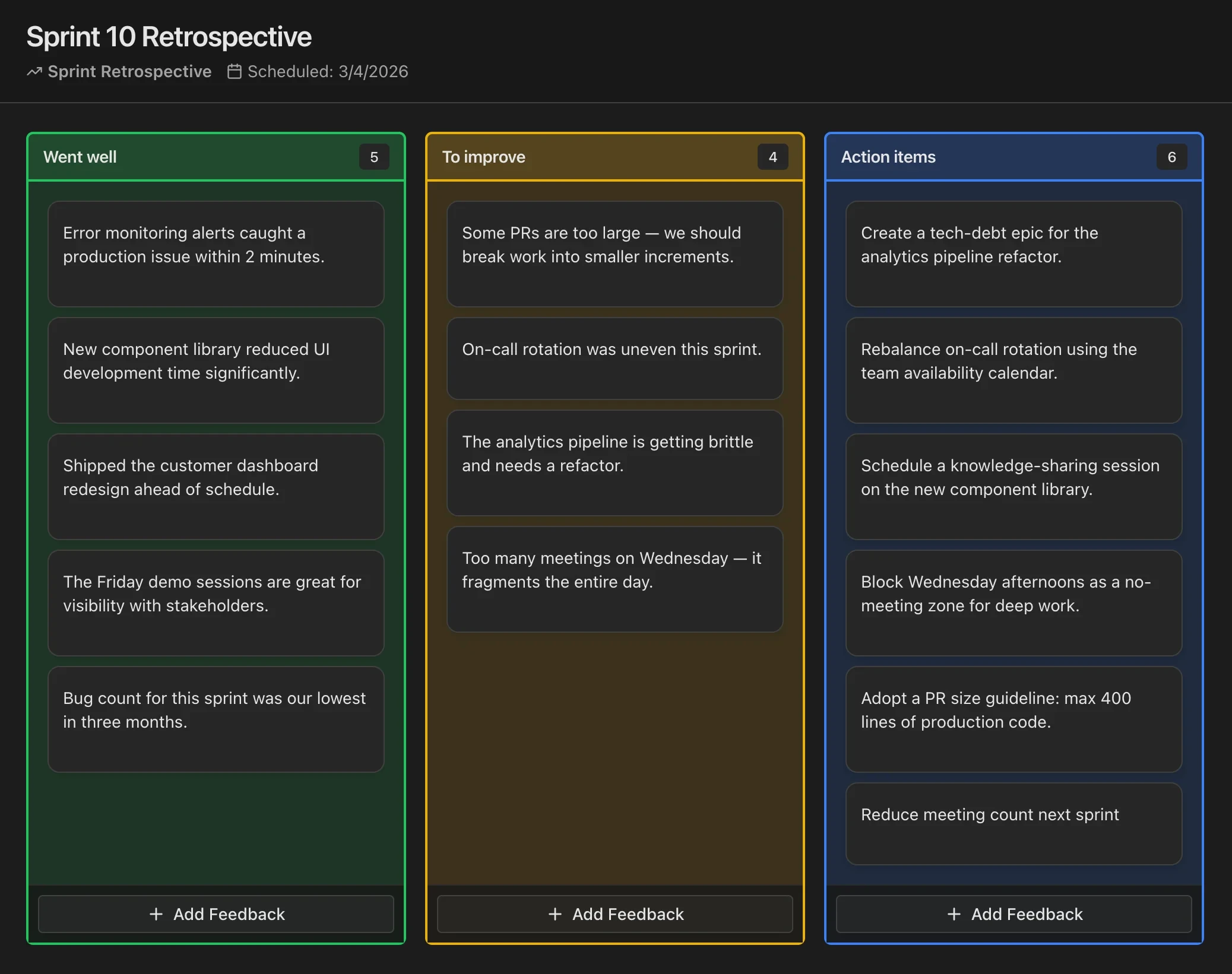
A common variation adds a third column: "Action" or "Ideas," turning it into a Plus-Delta-Action format that mirrors the classic Went Well-To Improve-Action Items but with the constructive framing of delta. Another adaptation for one-on-ones uses Plus Delta as a personal development framework where the individual reflects on their own performance with their manager. The delta framing is especially valuable in performance contexts because it focuses on growth rather than deficiency.

Run Retrospectives in CodeKudu
CodeKudu includes dozens of retrospective board templates, anonymous feedback, AI summaries, and action items that sync to GitHub Issues, Jira, and Linear.