

Pizza Retro
Crust, sauce, toppings, and oven—a playful frame for foundations through delivery.
Crust
Foundations: process basics, team agreements, infrastructure.
Sauce
What ties work together—communication, vision, prioritization.
Toppings
Variety and extras—nice-to-haves, polish, developer experience.
Oven
Heat and pressure—delivery constraints, deadlines, and quality bars.
This board is for demo purposes only. Your responses are not saved. Close or refresh the page to clear all cards. Do not add any sensitive information.
What is the Pizza Retro?
The Pizza Retro is a fun, food-themed retrospective format that uses pizza-making as a metaphor for how the team builds and delivers work. The format was created by agile facilitators looking for lighthearted alternatives to standard frameworks that could re-engage teams suffering from retrospective fatigue. The pizza metaphor is universally relatable and naturally sparks conversation because everyone has opinions about what makes a great pizza.
The four columns map pizza components to team dimensions. "Crust" represents the foundation—team agreements, infrastructure, basic processes, and technical foundations that everything else depends on. "Sauce" is the connective layer—communication, shared vision, and prioritization that ties the work together. "Toppings" represent the variety and extras—polish, developer experience, nice-to-haves, and the features that delight users. "Oven" symbolizes the delivery environment—constraints, deadlines, quality bars, and the pressure under which work is produced.
The pizza metaphor works because it captures an important truth about product development: the foundation matters more than the toppings. A pizza with a great crust and good sauce will always satisfy, even with simple toppings. But fancy toppings on a bad crust are a disappointment. This principle maps directly to software: solid architecture and clear communication matter more than feature richness built on a shaky foundation.
When to use the Pizza Retro
The Pizza Retro is perfect when the team needs to have a serious conversation about foundations versus features in a non-threatening way. Use it when the team has been focused on toppings (features, polish, user-facing work) at the expense of crust (infrastructure, testing, documentation). The pizza metaphor makes this trade-off visible and discussable without triggering defensiveness.
The format works well for teams of four to twelve people and fits into a 40 to 55 minute session. It is especially effective for teams that include non-technical stakeholders because the food metaphor makes technical concepts accessible. A product manager who does not understand technical debt immediately grasps that a thin, crumbly crust will not hold the toppings they want.
Use this format when the team morale could benefit from a lighter touch—after a stressful sprint, at the end of a long project, or simply when the regular retro format has become stale. Avoid it when the team has genuinely serious issues to discuss that would feel trivialized by a food metaphor. Reading the room is key: if the team is angry or anxious, a lighthearted format may feel dismissive.
How to facilitate the Pizza Retro
Start with a fun icebreaker: "If you could only eat one type of pizza for the rest of your life, what would it be?" This gets people talking and thinking in pizza terms. Then draw a pizza on the board with four labeled sections: crust, sauce, toppings, and oven. Briefly explain each metaphor and give the team six minutes for silent card writing.
Process the columns from the bottom up, just like building a pizza. Start with Crust: "How is our foundation?" This discussion often reveals infrastructure debt, testing gaps, or process fundamentals that need attention. Move to Sauce: "What ties our work together?" Look for communication breakdowns, alignment issues, or prioritization confusion. Then Toppings: "What are we adding, and is it the right stuff?" This surfaces feature scope discussions. Finally, Oven: "How is our delivery environment?" Discuss pace, quality, and pressure.
After processing all columns, ask the key synthesis question: "Is our pizza in balance? Are we adding toppings faster than our crust can support? Is the oven too hot (deadlines too tight) or too cold (no urgency)?" This balance discussion often produces the session most actionable insights. Close with one commitment per quadrant.
Tips for getting the most out of the Pizza Retro
The biggest facilitation challenge is keeping the metaphor productive without letting it become silly. The food theme naturally invites humor, which is fine in moderation, but the discussion needs to produce real insights. If the conversation drifts into extended pizza jokes, gently redirect: "That is a great pizza topping debate, but what does that mean for our team? What specific topping are we adding to our product that we should reconsider?"
The Oven column deserves special attention because it surfaces delivery pressure that the team may have normalized. "The oven is too hot" is a safe way to say "we are burning out" or "deadlines are unrealistic." When oven concerns emerge, probe deeper: "Is the heat coming from external expectations, our own estimates, or scope creep? What temperature would feel right?" These questions translate the metaphor into actionable conversations about pace and sustainability.
Use the crust-versus-toppings tension as a strategic tool. If the team identifies weak crust and heavy toppings, propose a "crust sprint"—one iteration focused on foundations before adding more features. The pizza metaphor makes this proposal intuitive: "We need to strengthen our crust before adding more toppings, or the whole thing falls apart." This framing is often more persuasive than abstract arguments about technical debt.
Variations and adaptations
For remote teams, use a visual pizza template on a digital whiteboard and consider having everyone actually order pizza during the retro. Shared food, even virtually, creates a relaxed atmosphere that loosens up conversation. Some remote teams have each person draw their own mini-pizza representing their sprint experience and share their drawing as a check-in.
For async teams, create a pizza-themed survey: "Rate our crust, sauce, toppings, and oven from one to five." Compile the results into a visual pizza scorecard that shows where the team agrees and disagrees about the state of each component. The synchronous session discusses the lowest-rated components and the areas of divergence.
A popular variation adds a fifth component: "The Customer" who is eating the pizza. This creates space to discuss user experience, customer feedback, and whether the team is making a pizza that people actually want to eat. Another adaptation for teams managing technical debt replaces the oven with "The Freezer"—work that has been put on ice and might spoil if left too long. This variation surfaces neglected tasks, deferred maintenance, and forgotten commitments that accumulate invisibly. Some teams also add a "Menu" column for upcoming sprint ideas, blending retrospective and planning into a single pizza-themed session.

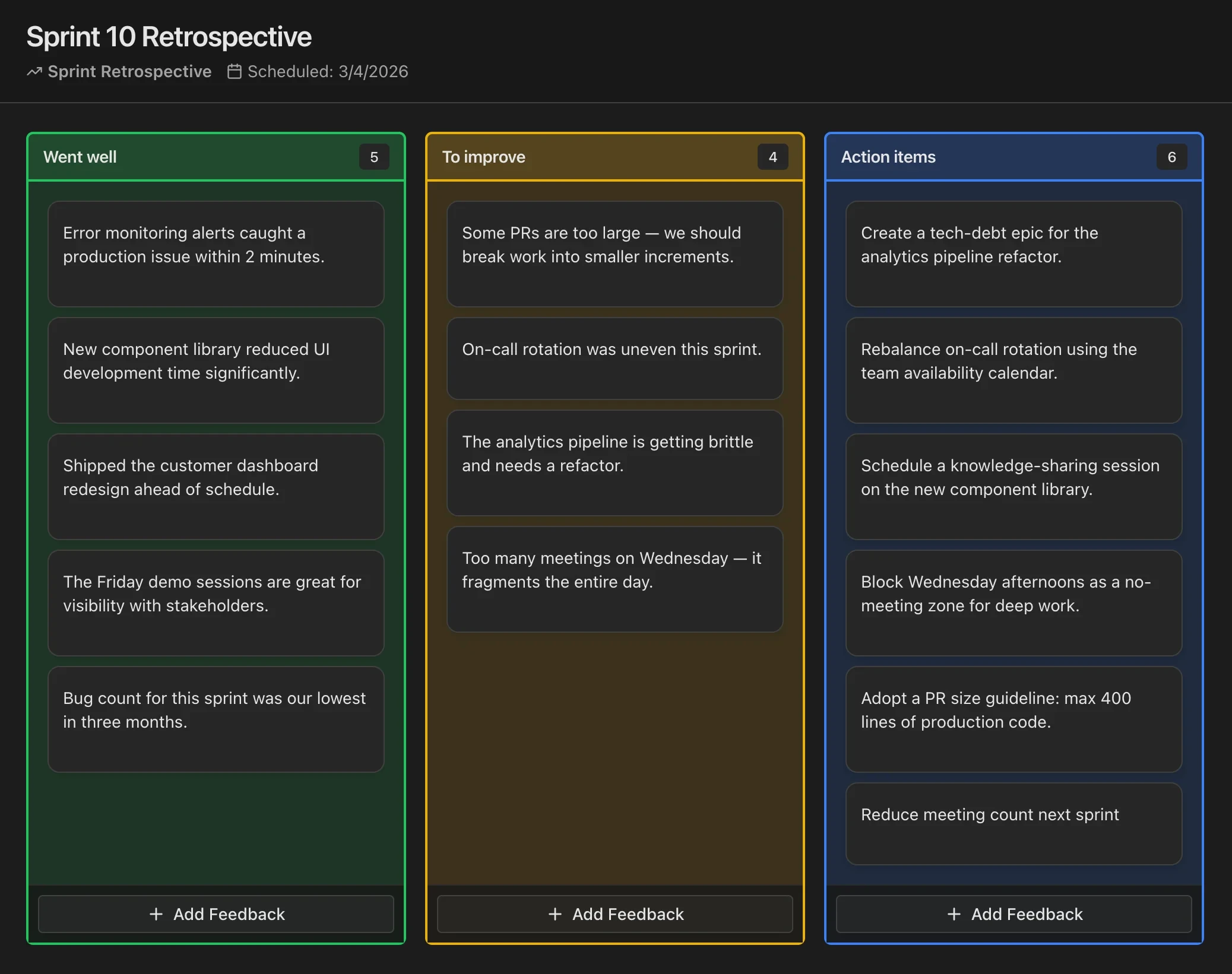
Run Retrospectives in CodeKudu
CodeKudu includes dozens of retrospective board templates, anonymous feedback, AI summaries, and action items that sync to GitHub Issues, Jira, and Linear.