

Liked - Lacked - Change
Short and clear: appreciate, name gaps, and commit to one meaningful change.
Liked
What did you value about how the team worked?
Lacked
What was missing for quality, speed, or wellbeing?
Change
What will you change next—specific and owned?
This board is for demo purposes only. Your responses are not saved. Close or refresh the page to clear all cards. Do not add any sensitive information.
What is Liked - Lacked - Change?
Liked - Lacked - Change is a streamlined retrospective format designed to move quickly from reflection to commitment. The format distills the retrospective process into its essential elements: acknowledging what worked, identifying what was missing, and committing to a specific change. Its origins trace to lean facilitators who believed that the simplest possible structure produces the most focused outcomes.
The three columns form a natural narrative arc. "Liked" captures positive experiences and effective practices. "Lacked" identifies gaps—things that were absent or insufficient. "Change" demands a concrete commitment. The key design decision is using "Change" instead of "To Improve" or "Action Items." The word "change" is singular and decisive, encouraging the team to commit to one meaningful shift rather than a scattered list of improvements.
This format is particularly effective because it forces prioritization by design. With only one "Change" column rather than a broad action item list, the team must converge on what matters most. This constraint is a feature, not a limitation—it prevents the retrospective from producing an ambitious but unrealistic improvement plan that nobody follows through on.
When to use Liked - Lacked - Change
Liked - Lacked - Change is ideal for teams that struggle with action item follow-through. If your retros consistently produce five or more action items and fewer than half get completed, this format discipline of focusing on one meaningful change will improve your improvement rate. It is also excellent for busy teams with limited retro time—a productive session can run in 20 to 30 minutes.
The format works well for teams of any size, from pairs to groups of twelve. For larger groups, the constraint of converging on a single change creates valuable prioritization conversations that broader formats do not force. Use it as your regular sprint retro format when the team values efficiency, or alternate it with deeper formats for periodic comprehensive reviews.
This format is especially powerful for teams early in their agile journey. The simplicity reduces facilitation skill requirements, and the single-change commitment teaches the discipline of focused improvement. Avoid it when the team faces multiple urgent issues that all need attention, or when deeper emotional processing is needed before jumping to change commitments.
How to facilitate Liked - Lacked - Change
Begin by reviewing the change committed to in the previous retro. Was it implemented? What was the result? This three-minute accountability check is critical and should never be skipped. Then give the team four to five minutes of silent writing for the Liked and Lacked columns. Deliberately do not populate the Change column yet—it should emerge from discussion, not individual brainstorming.
Process Liked quickly—two to three minutes of sharing and brief appreciation. Then spend the bulk of time on Lacked, grouping items and discussing which gaps had the most impact. Use dot-voting if needed to identify the top two or three issues. The critical facilitation moment comes next: guide the team to select one change that would address the most significant lack.
The Change should follow a specific format: "Starting next sprint, we will [specific action] to address [specific lack]. [Person] will ensure it happens." Write this as a complete sentence that the team reads aloud and agrees to. This formality may feel unusual, but it dramatically increases follow-through. One well-defined change is worth more than five vague intentions.
Tips for getting the most out of Liked - Lacked - Change
The hardest part of this format is converging on a single change when the team has identified multiple important gaps. Resist the temptation to add "just one more" change. If the team cannot agree on one, use a structured decision method: each person silently writes down which lack they would most want to address, then reveal simultaneously. This avoids anchoring bias and gives equal voice to all participants.
Make the Lacked column specific and systemic. "Lacked time" is too vague. "Lacked time for code review because three urgent bugs were escalated mid-sprint with no triage process" points to a specific systemic fix. The more specific the lack, the more targeted the change can be. Generic lacks lead to generic changes that do not stick.
Track your changes over time in a simple log. Date, what was lacked, what change was committed, and whether it was sustained. After ten sprints, review the log to see patterns: Are changes sticking? Are certain types of lacks recurring? This meta-retrospective on your retro process reveals whether the team is actually improving or just going through the motions.
Variations and adaptations
For remote teams, run the Liked and Lacked phases asynchronously on a shared board, then hold a short synchronous session focused exclusively on selecting and committing to the change. The synchronous time should be 15 to 20 minutes at most—just enough for discussion and decision. This hybrid approach respects async participants while preserving the collaborative energy needed for commitment.
For larger groups, use a "funnel" approach: breakout groups of three to four people each identify their top lack and proposed change, then representatives present to the full group, and the team votes on which single change to adopt. This scaling technique preserves individual voice while enabling large-group convergence on a single commitment.
A popular variation expands the Change column to "Change and Measure," requiring the team to define how they will know the change worked. This adds a scientific rigor: "We will add async code review with a 24-hour SLA, and we will measure the average review turnaround time next sprint to verify improvement." Another adaptation for teams in the storming phase of team development adds a fourth column: "Appreciate"—explicit peer-to-peer recognition that builds trust and reinforces the Liked column with personal attribution.

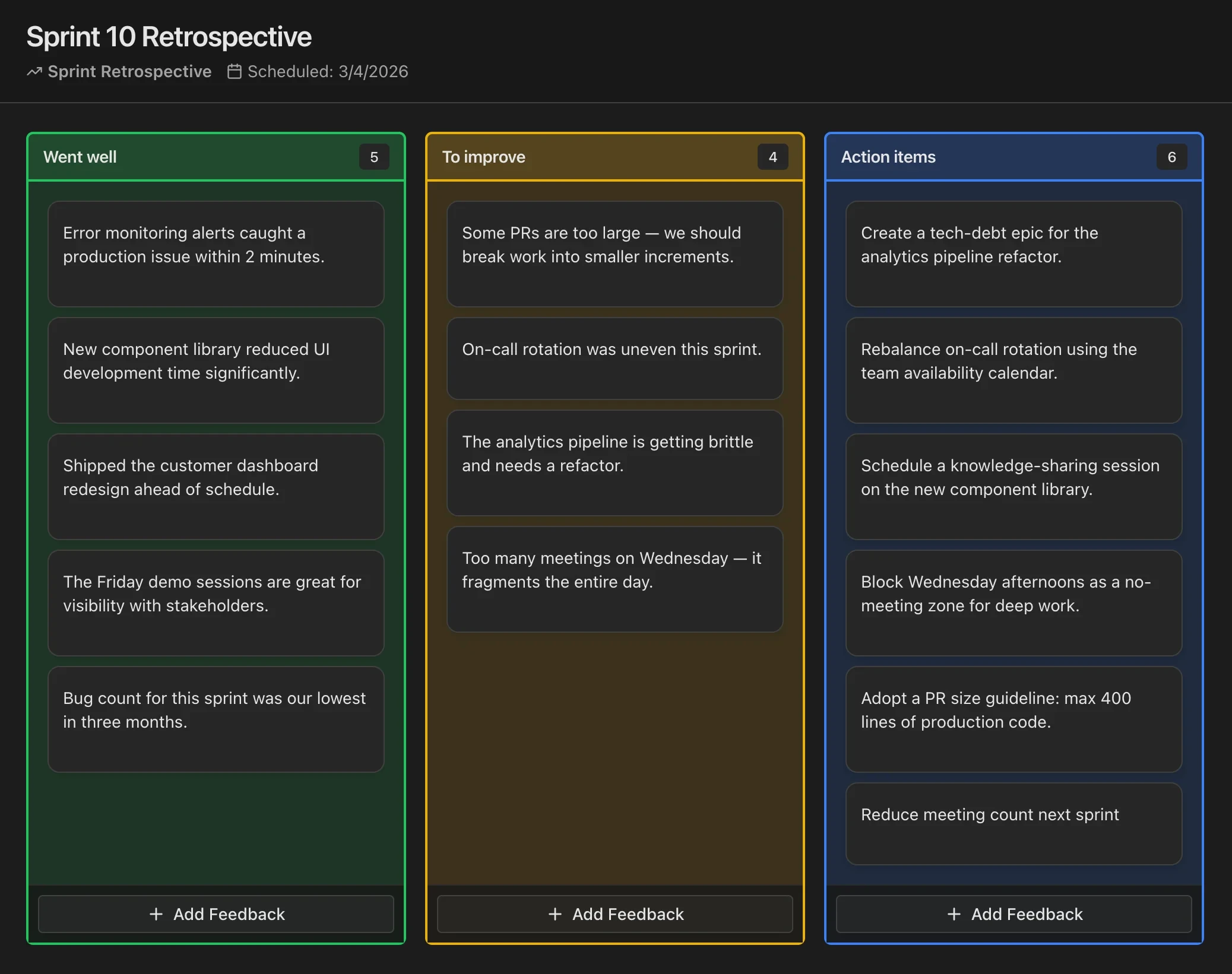
Run Retrospectives in CodeKudu
CodeKudu includes dozens of retrospective board templates, anonymous feedback, AI summaries, and action items that sync to GitHub Issues, Jira, and Linear.