

Lean Coffee
Democratic agenda: gather topics, dot vote, timebox discussion, capture outcomes.
To discuss
Topics the team wants to talk about—one card per theme.
Discussing
The active topic in the timebox—notes and tensions live here.
Actions
Decisions, owners, and follow-ups from the conversations.
This board is for demo purposes only. Your responses are not saved. Close or refresh the page to clear all cards. Do not add any sensitive information.
What is Lean Coffee?
Lean Coffee is a structured but agenda-free meeting format invented by Jim Benson and Jeremy Lightsmith in Seattle in 2009. Originally designed as a format for community meetups, it was quickly adopted by agile teams as a democratic retrospective approach where the participants collectively determine what to discuss. The name reflects its lean principles origin—maximize value, minimize waste, and let the people doing the work drive the conversation.
Unlike traditional retrospective formats that provide pre-defined categories (good/bad, start/stop), Lean Coffee starts with a blank slate. Participants propose topics, vote on what matters most, and discuss in timeboxed rounds. The three columns—To Discuss, Discussing, and Actions—represent workflow states rather than content categories. Topics move through this kanban-style flow as the session progresses.
The power of Lean Coffee lies in its democratic nature. In traditional retros, the format itself determines what gets discussed. In Lean Coffee, the team decides. This means the topics that surface are the ones the team cares about most, not the ones the format happens to prompt. This agency creates higher engagement and ensures the most pressing issues receive attention regardless of whether they fit a pre-defined category.
When to use Lean Coffee
Lean Coffee is ideal when the team has varied, potentially unrelated concerns that do not fit neatly into a single framework. Use it when standard retrospective formats feel constraining—when the team has issues ranging from technical debt to communication patterns to career development and no single framework accommodates them all. It is also excellent when retrospective fatigue has set in and the team needs a format that feels different.
The format works for any team size, though it shines with six to twelve participants where the diversity of topics is large enough to benefit from democratic selection. Sessions typically run 45 to 60 minutes. It is particularly valuable for teams that include members from different functions (engineering, design, product, QA) who bring fundamentally different perspectives and concerns.
Avoid Lean Coffee when the team has a specific known issue that needs deep exploration. The format is designed for breadth, not depth—timeboxed discussions of five minutes each are great for surface-level coverage but insufficient for complex root cause analysis. Also avoid it when the team is new and needs the scaffolding of a structured format to learn how to reflect effectively.
How to facilitate Lean Coffee
Begin with three minutes of silent topic generation. Each person writes one topic per card—a question, concern, idea, or observation they want to discuss. Keep it to one sentence. Then each person briefly pitches their topics in 15 seconds or less. After all pitches, everyone gets three dot votes to distribute among topics (including their own).
Sort topics by vote count, highest first. Pull the top topic into the "Discussing" column and set a five-minute timer. When the timer rings, do a quick thumbs vote: thumbs up to continue, thumbs down to move on. If the majority wants to continue, extend by three minutes. After discussion concludes, capture any action items and pull the next topic. Repeat until time runs out.
The facilitator's primary job is timekeeping and flow management. Resist the urge to extend every discussion—the timebox is what prevents one topic from consuming the entire session. When capturing actions, use the same format as any retro: specific action, owner, and deadline. Close by reviewing all actions and asking: "Did we cover what mattered most?"
Tips for getting the most out of Lean Coffee
The topic pitching phase is critical. If pitches are too long, they consume valuable discussion time. Enforce the 15-second rule firmly: "Tell us the topic in one sentence." If someone needs more than one sentence, the topic itself may need to be narrowed. Better: "How can we reduce PR review time?" rather than a three-minute backstory about how code reviews have been slow.
Do not skip the closing thumbs vote on each topic. It is tempting to let an engaging discussion run indefinitely, but this undermines the democratic principle of the format. The team voted on multiple topics, and each deserves a fair chance at discussion. If a topic needs more time, it can be revisited at the end if time permits, or it becomes a dedicated follow-up conversation.
Capture decisions and actions in real-time, visibly. Lean Coffee discussions can be rich but diffuse—without clear documentation, the value evaporates. Assign a note-taker who is not the facilitator, and review notes before closing. Topics that generated high engagement but no clear action item may need a follow-up working session to convert insights into concrete changes.
Variations and adaptations
For remote teams, Lean Coffee translates well to digital formats. Use a tool with built-in voting, timers, and kanban columns. The anonymous voting feature is especially valuable remotely because it prevents the anchoring effect of seeing senior team members vote first. Consider using a visible timer that all participants can see to create shared urgency and maintain energy.
For async teams, run the topic generation and voting phase asynchronously over 24 hours, then hold a synchronous session that jumps directly to discussion. This hybrid approach means the synchronous time is spent entirely on high-value conversation rather than logistics. Async participants who cannot attend the live session can add comments to topics they care about, ensuring their voice is represented.
A popular variation for retrospectives adds a "Parking Lot" column for topics that did not get discussed due to time constraints. These topics carry over to the next session and automatically get priority. This ensures important topics that did not win the vote still get eventual attention. Another adaptation adds themed rounds—the first round of topics must be about process, the second about people, and the third about technology. This scaffolding helps teams new to Lean Coffee generate more diverse topics.

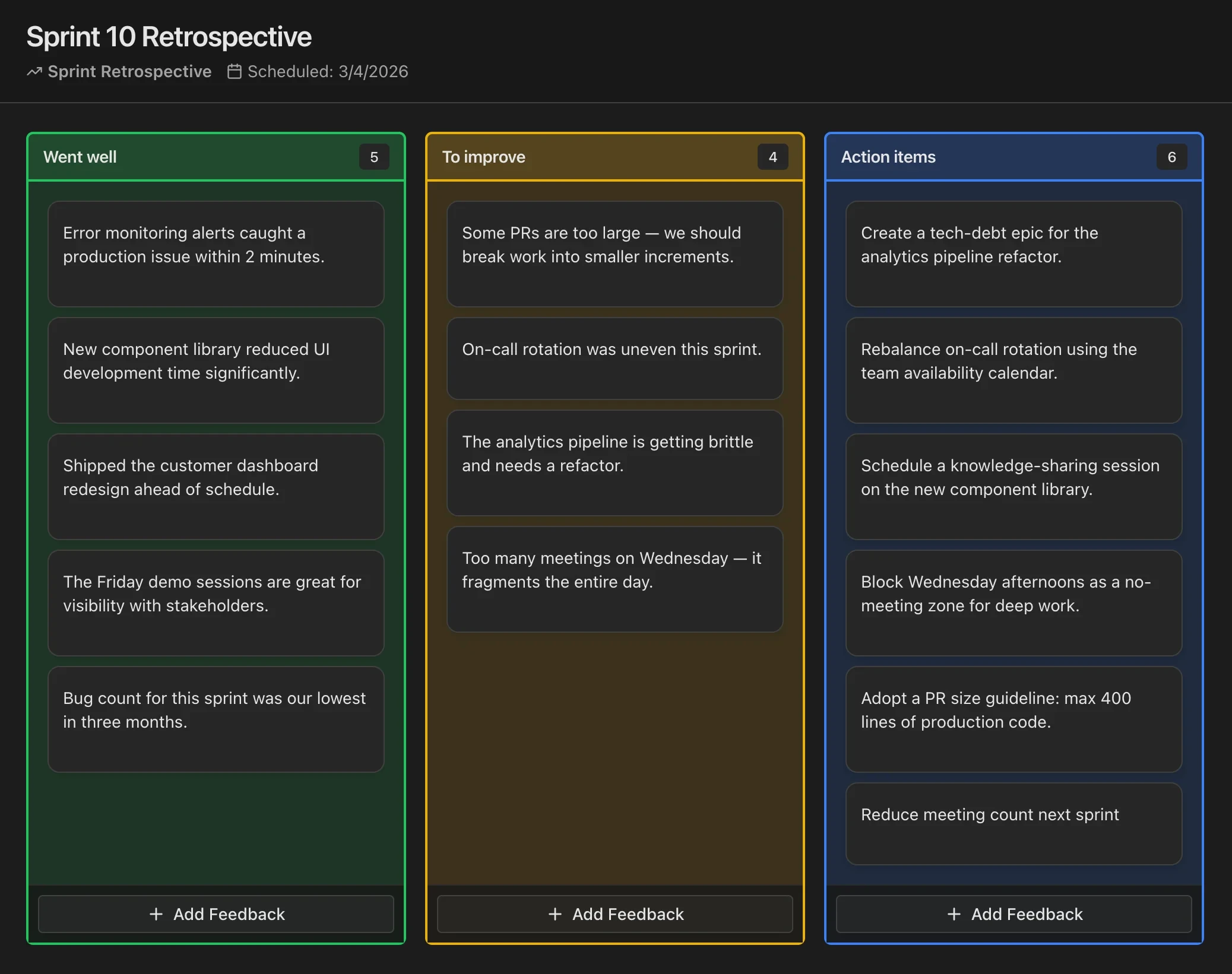
Run Retrospectives in CodeKudu
CodeKudu includes dozens of retrospective board templates, anonymous feedback, AI summaries, and action items that sync to GitHub Issues, Jira, and Linear.