

Three Little Pigs Retrospective
Straw, sticks, and brick houses show fragility versus resilience in how you build.
Straw house
Quick hacks or shortcuts that felt fragile or risky.
Stick house
Partially solid work—better, but still vulnerable.
Brick house
Durable solutions—tests, monitoring, clear design, strong teamwork.
The wolf
External pressures: incidents, scope churn, dependencies, surprises.
This board is for demo purposes only. Your responses are not saved. Close or refresh the page to clear all cards. Do not add any sensitive information.
What is the Three Little Pigs Retrospective?
The Three Little Pigs Retrospective uses the beloved fairy tale as a metaphor for evaluating the durability and resilience of the team's work. The story of three pigs building houses of straw, sticks, and bricks—only to have the first two blown down by the wolf—maps perfectly to software development, where shortcuts and fragile solutions often collapse under real-world pressure while robust engineering withstands scrutiny.
The four columns map fairy tale elements to team reality. "Straw House" captures quick hacks, shortcuts, and fragile solutions that got the job done but would not survive scrutiny. "Stick House" represents partially solid work—better than straw but still vulnerable to determined pressure. "Brick House" identifies durable solutions—well-tested code, clear documentation, solid architecture, and strong team practices that will stand up to any wolf. "The Wolf" represents external pressures—incidents, scope changes, dependencies, market shifts, or organizational surprises that test the strength of what the team has built.
This format is uniquely effective for conversations about technical quality and craftsmanship. The fairy tale framing makes it easy to discuss trade-offs between speed and durability without triggering defensive reactions. Saying "that feature is a straw house" is less confrontational than "that code is fragile and poorly designed" while conveying the same message.
When to use the Three Little Pigs Retrospective
This format is ideal after a release or project milestone when the team can evaluate the quality of what they shipped. It works especially well after an incident or production issue that exposed fragility—the wolf has already blown, and the team can reflect on which houses survived and which did not. It is also valuable when the team is accumulating technical debt and needs a constructive way to discuss the trade-offs between shipping fast and building to last.
Teams of four to ten people benefit most, and sessions run 45 to 60 minutes. The format is particularly effective for engineering-heavy teams who care deeply about code quality and craftsmanship. It is also great for mixed audiences—the fairy tale metaphor helps non-technical stakeholders understand why engineering investment in durability matters.
Use this format when you need to advocate for quality investment without sounding like you are complaining about timelines. The story is inherently persuasive: everyone knows the pig with the brick house was right. Avoid it when the team is demoralized about quality—if everything feels like a straw house, the format may amplify despair rather than inspire improvement. In those situations, start with an appreciative format before tackling quality concerns.
How to facilitate the Three Little Pigs Retrospective
Begin with a brief retelling of the story—even though everyone knows it, the shared narrative creates a playful atmosphere. Ask: "If the wolf came to our project today, what would still be standing?" Then give the team seven minutes to write cards for all four columns. Encourage concrete examples: specific features, services, processes, or practices rather than abstract assessments.
Process Brick House first to establish what the team is proud of. Ask: "What makes these brick houses strong? What practices produced this durability?" Understanding the conditions that create quality is as important as identifying where quality is lacking. Then address Stick House items: "What would it take to upgrade these to brick? Is it worth the investment?" Not every stick house needs to become a brick house—some things are appropriately built to a medium standard.
Move to Straw House, which is the most sensitive column. Frame it constructively: "Every team has straw houses—they are often the result of necessary trade-offs. The question is: which ones need rebuilding before the wolf comes?" Finally, discuss The Wolf: "What external pressures are we facing, and which of our houses are most vulnerable?" Close by selecting the highest-risk straw houses (fragile items facing imminent wolf pressure) and creating action items to strengthen them.
Tips for getting the most out of the Three Little Pigs Retrospective
The most important facilitation skill here is preventing the Straw House column from becoming a blame exercise. Straw houses often exist because of legitimate constraints—tight deadlines, changing requirements, or limited resources. When discussing straw houses, always ask: "What constraint led to this trade-off?" This contextualizes the decision and prevents the person who built the straw house from feeling attacked. The goal is to address the constraint, not to criticize the builder.
The Wolf column creates urgency that other formats lack. When the team identifies a specific wolf (an upcoming audit, a competitor launch, or a traffic spike), the connection to vulnerable straw houses becomes visceral. Use this urgency constructively: "This wolf is coming in three sprints. Can we upgrade this straw house to at least sticks before then?" Time-bound threats create more motivation than abstract quality aspirations.
Track your house inventory over time. Maintain a simple register of straw, stick, and brick items. As the team upgrades straw to sticks and sticks to bricks, the register visualizes quality improvement. If the straw list keeps growing despite improvement efforts, it signals that the team is building straw faster than they are upgrading it—a structural problem that needs an organizational conversation about pace and standards.
Variations and adaptations
For remote teams, use a visual board with actual house illustrations at three quality levels. Consider having team members drag specific features or components to the appropriate house, creating a visual quality map of the product. This interactive exercise works better digitally than on paper because items can be easily moved between houses as the discussion reveals different perspectives on quality levels.
For async teams, create a shared inventory of recent deliverables and ask each team member to categorize them as straw, sticks, or bricks with a brief justification. When categorizations diverge—one person rates a feature as sticks while another rates it as brick—the disagreement becomes a valuable discussion topic. These divergences often reveal different definitions of quality or different awareness of hidden fragility.
A powerful variation adds a "Blueprint" column representing the team's quality standards and architectural guidelines. This addition creates space to discuss not just the current state of houses but the building code the team aspires to follow. Another adaptation for teams near a major deadline adds a "Shelter" column—temporary protections (feature flags, monitoring, rollback plans) that protect straw houses until they can be properly rebuilt. This pragmatic addition acknowledges that sometimes you cannot upgrade to brick before the wolf arrives, but you can add sandbags and a smoke alarm.
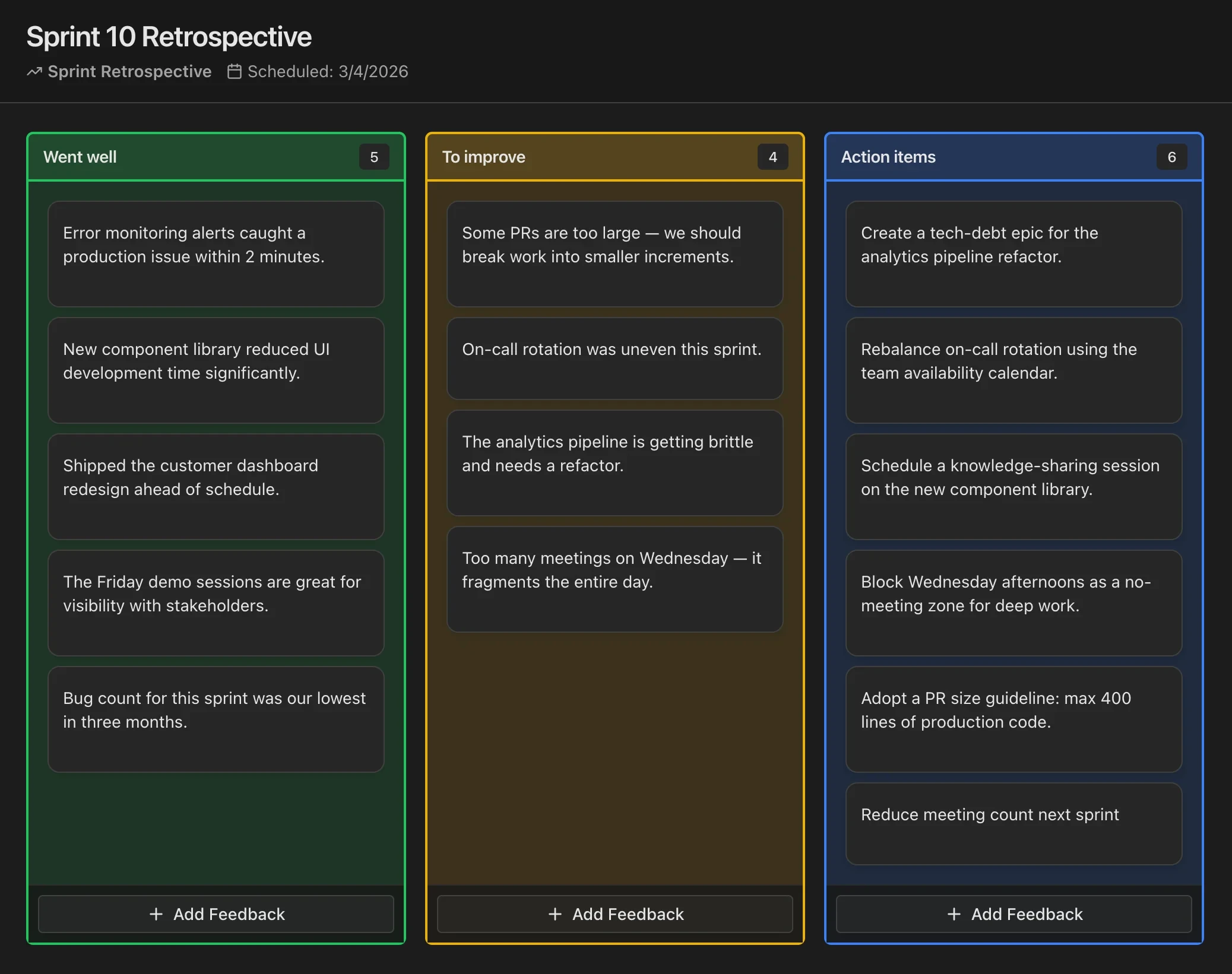
Run Retrospectives in CodeKudu
CodeKudu includes dozens of retrospective board templates, anonymous feedback, AI summaries, and action items that sync to GitHub Issues, Jira, and Linear.