

Mad Sad Glad
Name feelings safely so the team can discuss tensions and wins with empathy.
Mad
Frustrations, blockers, or things that felt unfair or wasteful.
Sad
Disappointments, losses, or moments that drained morale.
Glad
Highlights, gratitude, and moments that created energy.
This board is for demo purposes only. Your responses are not saved. Close or refresh the page to clear all cards. Do not add any sensitive information.
What is Mad Sad Glad?
Mad Sad Glad is an emotion-centered retrospective format that invites team members to name their feelings as the primary lens for reflection. The format has roots in emotional intelligence frameworks and was adopted by agile coaches in the mid-2000s as a way to surface the human side of teamwork that purely process-oriented retros often miss. It has since become one of the most popular formats for teams that value psychological safety.
The three columns map to fundamental emotional states. "Mad" captures frustration, anger, and irritation—the feelings that arise when expectations are violated or when obstacles feel unnecessary. "Sad" covers disappointment, loss, and demoralization—the quieter emotions that erode engagement over time. "Glad" holds joy, satisfaction, and pride—the emotions that fuel motivation and retention.
By leading with emotions rather than processes, Mad Sad Glad often surfaces issues that other formats miss entirely. A team member might not mention a workflow problem in a standard retro but will readily share that they felt frustrated when their pull request sat unreviewed for three days. The emotion becomes the doorway to the systemic issue.
When to use Mad Sad Glad
Mad Sad Glad is most valuable when team dynamics need attention. Use it after a particularly intense sprint, during periods of conflict, after team composition changes, or when you sense unspoken tensions beneath the surface. It is also excellent as a periodic check-in every four to six sprints, even when things seem fine, because it reveals simmering issues before they become crises.
The format works best with teams of three to eight people where participants know each other well enough to be vulnerable. For newly formed teams, the emotional exposure may feel uncomfortable—consider starting with a lighter format like Happy-Meh-Sad first. For very large groups, break into smaller circles of four to five people for the sharing portion, then aggregate themes.
Avoid this format if the team is in a blame-heavy culture where emotions are likely to be weaponized rather than heard. In those situations, the facilitator needs to do significant groundwork on psychological safety before introducing an emotion-first format. Also avoid it immediately before a critical deadline when the team needs tactical focus rather than emotional processing.
How to facilitate Mad Sad Glad
Facilitation quality matters more here than in any other retro format. Begin by explicitly setting ground rules: feelings are valid, this is a blame-free space, we listen without interrupting, and what is shared here stays here. Consider a brief grounding exercise—30 seconds of silence or a one-word check-in—to transition from work mode to reflection mode.
Give participants five to eight minutes of silent writing time. Some people may need prompting: "Think about a moment this sprint when you felt a strong emotion—what happened and what column does it belong in?" After writing, process one column at a time. Start with "Glad" to build positive momentum and safety. Move to "Sad" next, which is usually gentler than "Mad." End with "Mad" when the group has warmed up.
As each person shares, practice active listening as the facilitator. Reflect back what you hear: "It sounds like the lack of clarity on priorities made you feel like your effort was wasted." This validates the emotion and naturally transitions to identifying root causes. After all sharing is complete, identify patterns across columns and convert the top themes into action items that address both the emotional need and the systemic issue.
Tips for getting the most out of Mad Sad Glad
The most critical facilitation skill for this format is ensuring "Mad" does not become an attack session. When someone says they are mad at a specific person, redirect to the situation: "What about that situation made you feel that way?" This shifts from blame to understanding and keeps the space safe for everyone, including the person being referenced.
Encourage people to dig beneath the surface emotion. "I am mad about the scope change" becomes more useful as "I am mad because I felt my input on feasibility was dismissed when scope changed without engineering consultation." The deeper you go, the more actionable the insight becomes.
Do not skip the "Glad" column or treat it as a warm-up. Genuine celebration and gratitude are powerful team-building tools. When someone shares what made them glad, ask follow-up questions: "What made that collaboration work so well? How can we create more moments like that?" The positive column is where you discover your team superpowers. Balance the time roughly equally across all three columns.
Variations and adaptations
For remote teams, anonymous card submission is almost essential for the "Mad" column. Use a tool that allows anonymous contributions so people can share frustrations without fear of attribution. During the synchronous discussion, read anonymous cards aloud and invite general reactions rather than trying to identify the author.
For asynchronous teams, consider a two-phase approach. Phase one is individual journaling: each person writes a private reflection on their mad, sad, and glad moments. Phase two is a synchronous session where people share what they are comfortable sharing. The journaling phase ensures people process emotions thoughtfully rather than reactively.
A powerful variation adds a fourth column: "Afraid." This creates space for anxiety about the future—concerns about upcoming changes, job security, or team direction that do not fit neatly into mad, sad, or glad. Another adaptation for teams that are new to emotional retros is to use emoji or color gradients instead of words, allowing people to express intensity without fully articulating feelings they are still processing. Some facilitators also add a brief closing ritual where each person shares one word describing how they feel after the retro compared to how they felt at the start.

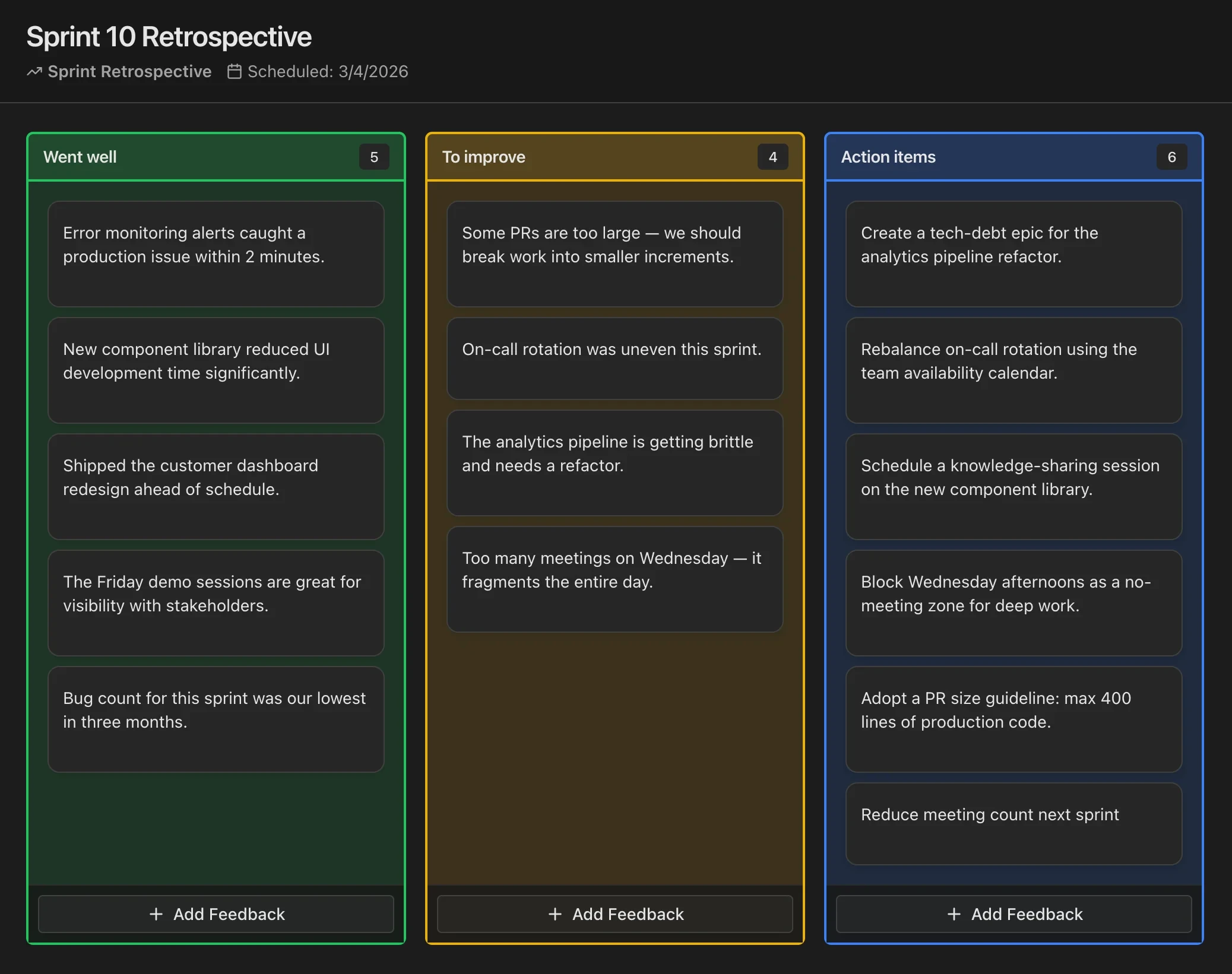
Run Retrospectives in CodeKudu
CodeKudu includes dozens of retrospective board templates, anonymous feedback, AI summaries, and action items that sync to GitHub Issues, Jira, and Linear.