

Hope - Worry - Risk - Mitigation
Forward-looking balance of optimism, fear, exposure, and concrete safeguards.
Hope
Outcomes you want to see and believe are possible.
Worry
Concerns that keep people up at night—name them safely.
Risk
Specific threats to scope, quality, people, or reputation.
Mitigation
What you will do to lower risk or prepare responses.
This board is for demo purposes only. Your responses are not saved. Close or refresh the page to clear all cards. Do not add any sensitive information.
What is Hope - Worry - Risk - Mitigation?
Hope - Worry - Risk - Mitigation is a forward-looking retrospective format—sometimes called a "futurespective"—that focuses on what lies ahead rather than what has already happened. The format was popularized by agile coaches who recognized that teams often need structured space to discuss their expectations, fears, and preparedness for upcoming challenges. Traditional retrospectives look backward; this format looks forward while using the emotional lens of hope and worry to surface concerns that purely analytical risk assessments miss.
The four columns create a progression from emotion to action. "Hope" captures what the team is optimistic about—desired outcomes, opportunities, and aspirations. "Worry" names anxieties and fears—the things that keep team members up at night but are often left unspoken. "Risk" translates worries into formal risk statements—specific threats to scope, quality, timelines, or people. "Mitigation" defines concrete actions the team will take to reduce risk likelihood or impact.
The deliberate separation of Worry from Risk is a key design choice. Worries are emotional and subjective—they may not be rational, but they affect team behavior and morale regardless. Risks are analytical and assessable—they have probability and impact. By honoring both dimensions, this format ensures that emotional concerns receive attention alongside rational risk assessment, producing a more complete picture of the team preparedness.
When to use Hope - Worry - Risk - Mitigation
This format is ideal at the beginning of a new project, before a major release, or at any point where the team faces significant upcoming uncertainty. It is the perfect format for sprint zero or iteration zero when the team is planning but has not yet started execution. It is also valuable before a team or organizational change—new members joining, reorganization, or technology migration—when the future feels uncertain.
Teams of four to twelve people benefit most, and sessions run 50 to 60 minutes. The format works well for cross-functional groups because different roles bring different hopes and worries: product managers hope for user adoption, engineers worry about performance, and designers worry about usability. These diverse perspectives create a richer risk landscape than any single role could generate.
Use this format whenever backward-looking retros feel stale or when the team is spending more energy worrying about the future than reflecting on the past. Avoid it immediately after a major failure, when the team needs to process what happened before looking ahead. Also avoid it for routine sprints where the upcoming work is well-understood and low-risk—the format loses its power when the future is predictable.
How to facilitate Hope - Worry - Risk - Mitigation
Open with a brief forward-looking prompt: "Think about where we will be in four weeks. What does success look like? What keeps you up at night?" Give the team seven to eight minutes to write cards for Hope and Worry simultaneously. Process Hope first—sharing aspirations creates a positive foundation and establishes what the team is working toward. This is not just a warm-up; hopes define the context for all subsequent discussion.
Process Worry next, with empathy and without judgment. Validate each worry: "It is completely reasonable to worry about that." After all worries are shared, facilitate the transition to Risk: "Which of these worries represent real, specific risks we can assess and mitigate?" Not every worry becomes a risk—some are general anxiety that is best addressed through reassurance rather than planning. Help the team distinguish between actionable risks and general unease.
For each identified risk, populate the Mitigation column collaboratively: "What can we do now to prevent this or reduce its impact?" Mitigations should be specific actions with owners. Close by pairing each hope with the risks that could prevent it, creating a clear narrative: "We hope for X, which is at risk due to Y, and we are mitigating by doing Z." This narrative structure makes the output memorable and actionable.
Tips for getting the most out of Hope - Worry - Risk - Mitigation
The "Worry" column requires the most facilitation skill because it asks people to be vulnerable about their fears. Some participants will self-censor, worried about appearing pessimistic or disloyal. Normalize worry by sharing your own: "I will go first—I am worried about our timeline because two team members are on vacation next sprint." Facilitator vulnerability creates permission for others to be honest.
Be rigorous about converting worries into risks. A worry like "I am worried about quality" becomes a risk like "If we ship the new search feature without load testing, there is a high probability of performance degradation affecting user experience during peak hours." The specificity transforms a vague concern into something the team can actually address. Worries that cannot be converted into specific risks may indicate a need for more information—which itself becomes an action item.
Do not neglect the Hope column. Research on team motivation shows that hope is not just a nice feeling—it directly influences effort, creativity, and resilience. When the team articulates shared hopes, they create a motivational anchor that sustains them through the challenges ahead. Revisit the hopes throughout the project to check whether the team is moving toward their aspirations or has lost sight of them.
Variations and adaptations
For remote teams, run the Hope and Worry phases as anonymous submissions to lower the vulnerability barrier. Display all cards without attribution, then discuss them as group observations rather than individual confessions. This anonymity is especially important for worry expression in remote settings where social cues that normally convey safety are absent.
For async teams, distribute the Hope and Worry collection over several days, allowing team members to add items as they think of them rather than generating everything in one sitting. Worries often surface at unexpected moments—during a code review, reading a requirement, or talking to a stakeholder. Capturing them in real-time produces a more complete worry inventory. The synchronous session focuses on the Risk and Mitigation columns, which benefit from collaborative discussion.
A powerful variation adds a "Resources" column between Risk and Mitigation, identifying what assets, relationships, or capabilities the team already has that could help address risks. This strengths-based addition prevents the session from feeling entirely defensive and reminds the team of their existing capacity. Another adaptation for program-level planning runs Hope-Worry-Risk-Mitigation across multiple teams simultaneously, then combines the results to identify shared risks that need cross-team or organizational mitigation strategies.

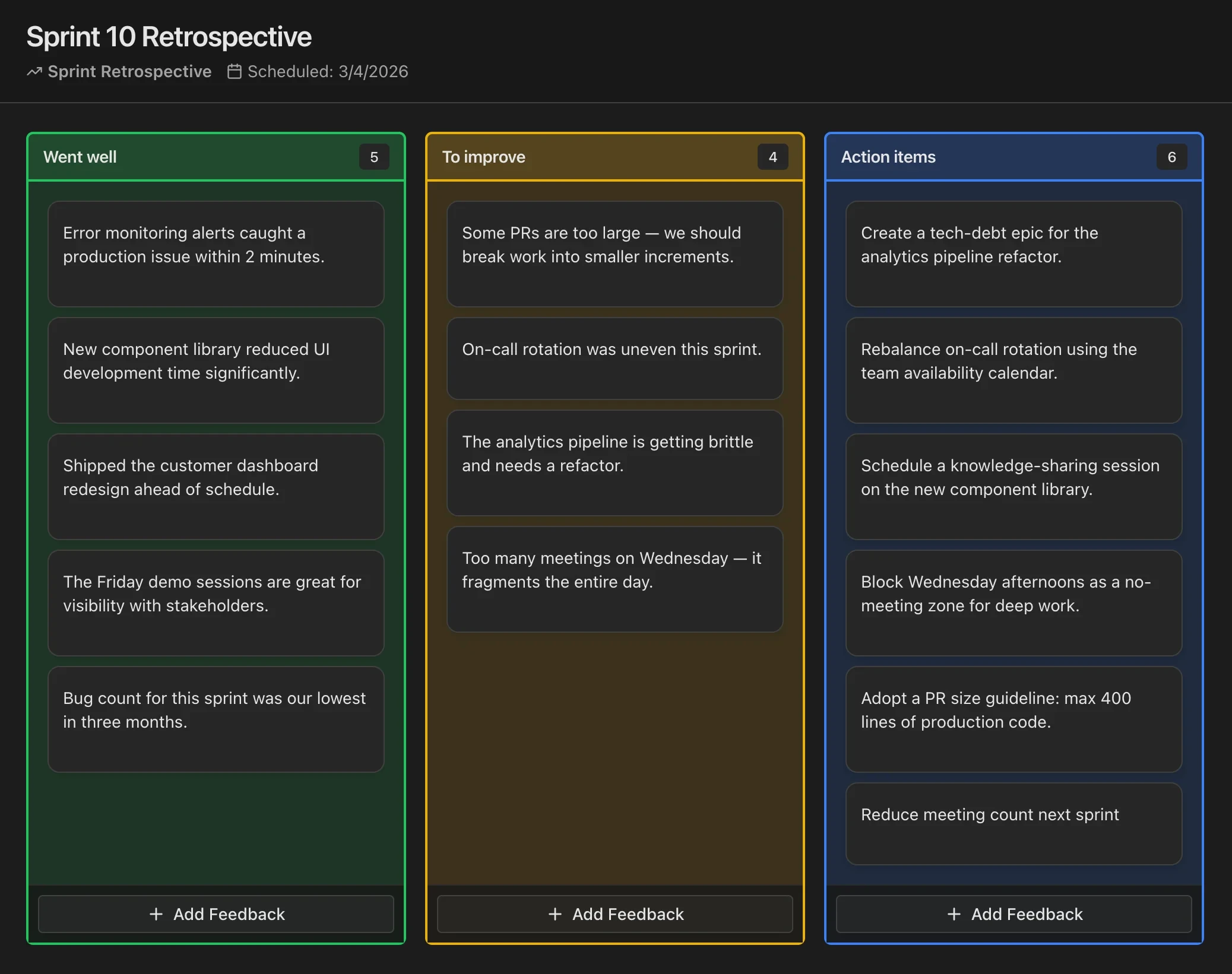
Run Retrospectives in CodeKudu
CodeKudu includes dozens of retrospective board templates, anonymous feedback, AI summaries, and action items that sync to GitHub Issues, Jira, and Linear.